Black Friday weekend 2025 painted two very different pictures for furniture and mattress retailers. Furniture stores continued to see declines in foot traffic—double-digit drops on most days—while mattress stores saw stronger weekend activity, especially on Sunday and Monday. Revenue followed those patterns too, with furniture holding steady thanks to higher tickets and strong conversion, and mattress retailers experiencing a mix of big wins and tough misses depending on the day.
What stood out most this year was how differently shoppers behaved across the two categories. Furniture buyers were fewer in number but more intentional when they showed up, while mattress stores dealt with the challenge of higher traffic moving through a very hands-on sales process. These contrasting dynamics reinforced something we’ve seen growing over the past few years: furniture and mattress may share the same holiday weekend, but they require very different strategies to perform well during it.
Furniture Industry
Foot Traffic
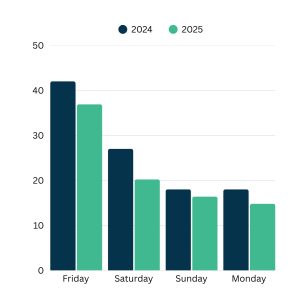
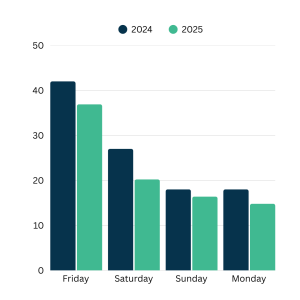
Furniture foot traffic declined year over year across all four days, continuing the long-term trend away from in-store Black Friday shopping. Friday fell from 42.0 to 36.9 visitors (-12.1%), with Saturday dropping from 27.0 to 20.2 (-25.2%) and Sunday from 18.0 to 16.4 (-8.9%). Even Cyber Monday saw a decline from 18.0 to 14.8 (-17.8%). The pattern suggests consumers are spreading out their shopping—both online and earlier in November—reducing the peak intensity that once defined Black Friday weekend in furniture.
Average Ticket
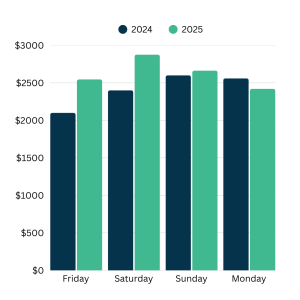
Average ticket increased across all four days, showing strong consumer willingness to spend even in a lower-traffic environment. Friday climbed from $2,100 to $2,546 (+21%), Saturday from $2,400 to $2,876 (+20%), and Sunday held a modest increase from $2,600 to $2,634. Monday was the only day with a slight decline ($2,560 to $2,421). Larger tickets combined with stable conversion helped soften the impact of fewer visitors.
Daily Revenue
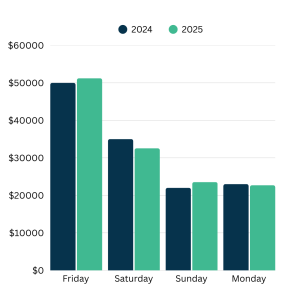
Daily revenue trends largely mirrored traffic declines, with meaningful drops on Saturday and milder declines on Sunday and Monday. Friday revenue increased slightly ($50,000 to $51,217, +2.4%), but Saturday fell from $35,000 to $32,545 (-7%). Sunday dipped from $22,000 to $23,549 (+7% improvement driven by higher conversion), while Monday held nearly flat ($23,000 to $22,697). Overall, the weekend showed that strong in-store execution can partially offset structural shifts in foot traffic—but not fully compensate for it.
Sales Conversion
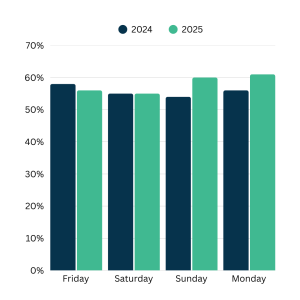
Furniture conversion remained remarkably stable year over year, with only slight shifts by day. Friday dipped from 58% to 56%, while Saturday held steady at 55%. Sunday actually improved (54% to 60%), and Monday rose modestly from 56% to 61%. Despite weaker traffic, well-prepared stores converted a higher share of serious shoppers—highlighting that operational discipline, not volume, ultimately determines weekend performance.
Mattress Industry
Foot Traffic
Mattress traffic increased year over year on every day of the weekend. Friday rose from 9.0 to 10.4 visitors (+15.6%), Saturday from 7.0 to 5.8 (a slight decline, –17.1%), but Sunday and Monday showed meaningful gains—from 3.0 to 5.4 and 3.0 to 5.6 respectively (both +80%+). Even with small denominators, the upward movement suggests that mattress shoppers disproportionately returned to in-person evaluation during Black Friday, relying more on try-before-buy decisions than online research alone.
Average Ticket
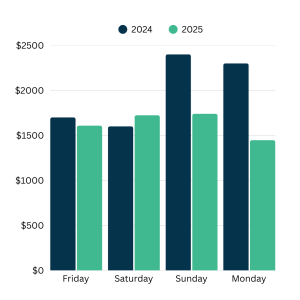
Average ticket was mixed compared to last year. Friday slipped slightly from $1,700 to $1,608, while Saturday increased from $1,600 to $1,724. Sunday fell meaningfully from $2,400 to $1,741 as lower-ticket promotional items drove volume, and Monday declined from $2,300 to $1,448. The volatility reflects a more promotion-heavy mattress environment this year, with shoppers responding to deals rather than premium models.
Daily Revenue
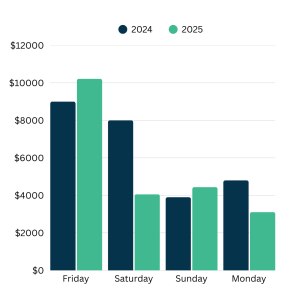
Daily revenue increased sharply on Friday ($9,000 to $10,217, +13.5%) but declined across the remaining days. Saturday fell by 49% ($8,000 to $4,060), Sunday dropped slightly ($3,900 to $4,443, +14% gain), and Monday decreased from $4,800 to $3,110 (-35%). The spread illustrates how dependent mattress stores are on staffing balance: when teams can manage higher traffic (Friday, Sunday), revenue climbs; when they cannot (Saturday, Monday), performance drops quickly.
Conversion Rate
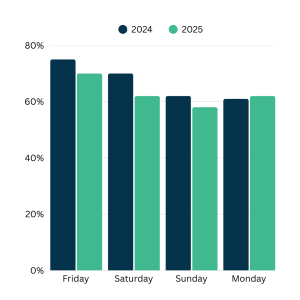
Mattress conversion softened slightly year over year. Friday fell from 75% to 70%, Saturday from 70% to 62%, and Sunday from 62% to 58%. Monday held steady at 62% year over year. While still very high relative to furniture, the small declines reflect the operational reality: even modest increases in traffic can strain the highly personal, one-to-one sales process mattress stores depend on.
Conclusion
The results from Black Friday weekend 2025 make it clear that home goods retail is still in transition—and that the furniture and mattress sectors are evolving in their own unique ways. Furniture traffic may be slipping, but stronger conversion and healthier tickets suggest that the shoppers who do visit are more serious and more prepared to buy. On the other hand, mattress retailers are attracting more people across the weekend, but the uneven revenue results show how important staffing balance and sales process management are when traffic spikes.
These differences are a reminder that there’s no single Black Friday strategy that works for both categories. Furniture retailers can learn from the mattress sector’s ability to spread shopper interest across the weekend, while mattress stores can take cues from furniture’s efficiency in converting fewer visitors into strong sales. As the holiday landscape continues to shift, blending the strengths of both approaches will be key to building smarter, more resilient Black Friday playbooks moving forward.