Fourth of July Analysis 2026

Every year, the July 4th holiday weekend is one of the biggest traffic and revenue events on the retail calendar for furniture and mattress stores — but this year came with a twist.

This year, July 4th fell on a Saturday; last year, it fell on a Friday. That single-day shift didn’t just move a date on the calendar — it appears to have moved the entire weekend’s peak shopping day right along with it, with furniture traffic and revenue cresting a full day earlier than it did in 2025. And while shoppers changed when they came in, one thing didn’t budge: holiday shoppers spent bigger than everyone else, both years, no matter which day of the week the 4th landed on.

So did stores actually have a weaker holiday weekend this year, or did the calendar just play a trick on the numbers? That’s what we set out to answer — anchoring the comparison on each day’s position relative to the holiday (the day before, the holiday itself, and the days after) rather than the calendar date, so we’re comparing like for like regardless of which day of the week the 4th landed on.

Below, we break down traffic, revenue, ticket size, prospecting, and conversion data for both furniture and mattress retailers across the holiday window, comparing this year’s performance to last year’s.

Furniture Industry

Foot Traffic

Foot traffic among the top-tier stores told two very different stories this year. In 2025, traffic built steadily and peaked the day after the holiday (Saturday, 26.4 opportunities) — a classic “shoppers wait for the weekend” pattern.

In 2026, traffic peaked the day before the holiday (Friday, 21.2) and fell every day after, ending the window at just 12.8 — the lowest point across either year’s window. Moving the holiday onto Saturday appears to have pulled the peak shopping day forward rather than extending it into a longer high-traffic stretch.

Average Ticket

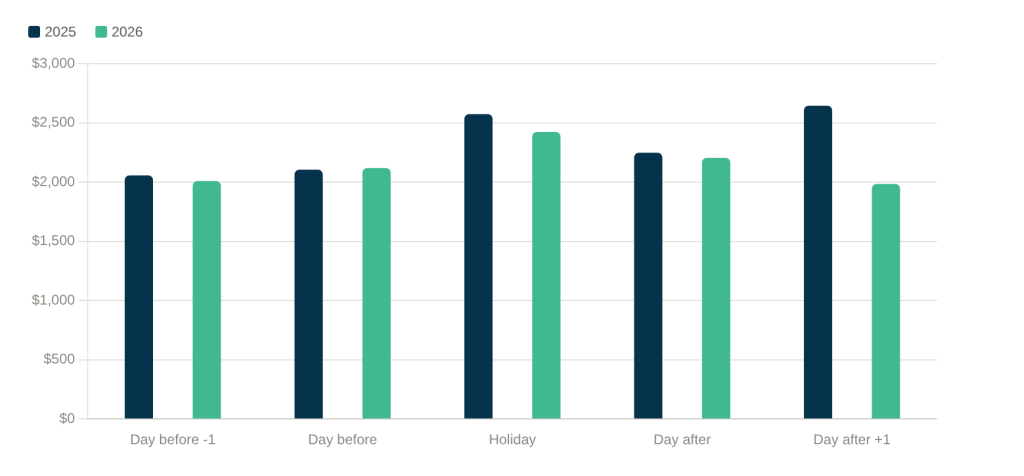
Average ticket is the one metric where both years agree on the shape: the holiday itself is the peak spending day ($2,575 in 2025, $2,425 in 2026), even though it wasn’t the peak traffic day in either year. Holiday shoppers bought bigger, less often — and that ticket size was down 5.8% year-over-year on the holiday itself.

Daily Revenue

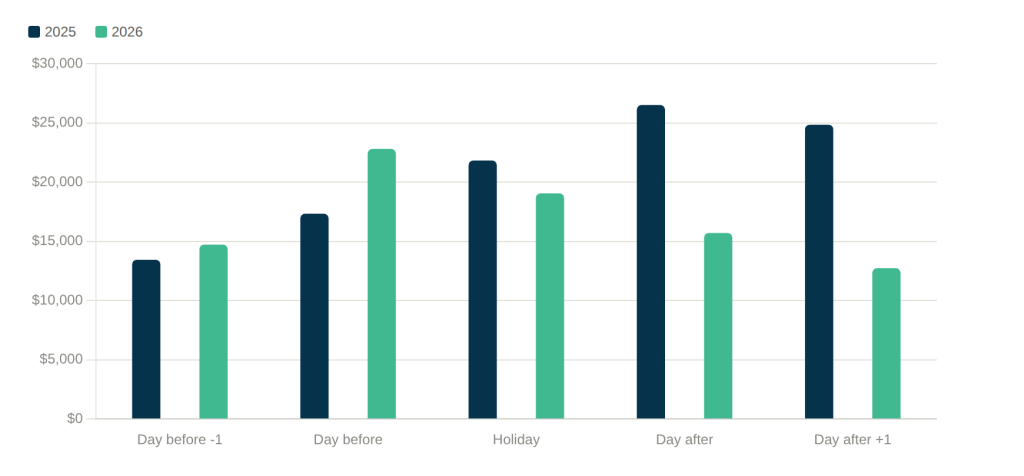
Revenue mirrors that traffic shift closely: 2025 revenue peaked the day after the holiday ($26,520), while 2026 peaked the day before ($22,813) and declined steadily from there — down 44% by the last day in the window compared to the holiday itself.

Sales Conversion

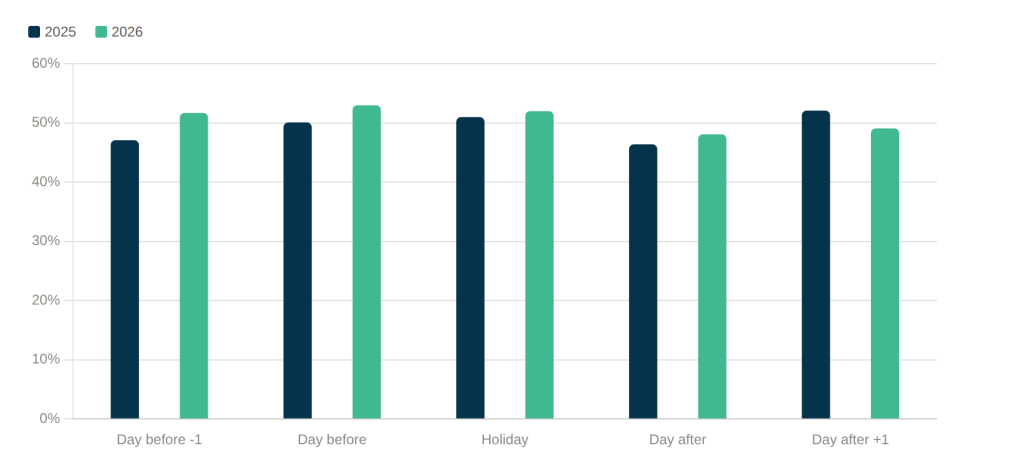
Among the top-converting stores, 2026 ran ahead of 2025 for most of the window — higher on the day before-1 (51.7% vs 47.1%), day before (53.0% vs 50.1%), the holiday itself (52.0% vs 51.0%), and day after (48.1% vs 46.4%).

The one day it flips is day after+1, where 2025 pulls ahead (52.1% vs 49.1%). Overall, this is the most stable of the six metrics year-over-year — a tight band in the high-40s to low-50s both years — which lines up with the earlier finding that traffic and revenue shifted timing significantly while conversion efficiency at the top stores stayed fairly consistent.

Mattress Industry

Foot Traffic

Traffic among top-converting mattress stores essentially flipped year over year. In 2025, the holiday itself was the slowestday (1.6 opportunities), with traffic building afterward to a Saturday peak (4.0). In 2026, the holiday was the busiest day (5.4) — the opposite pattern.

Average Ticket

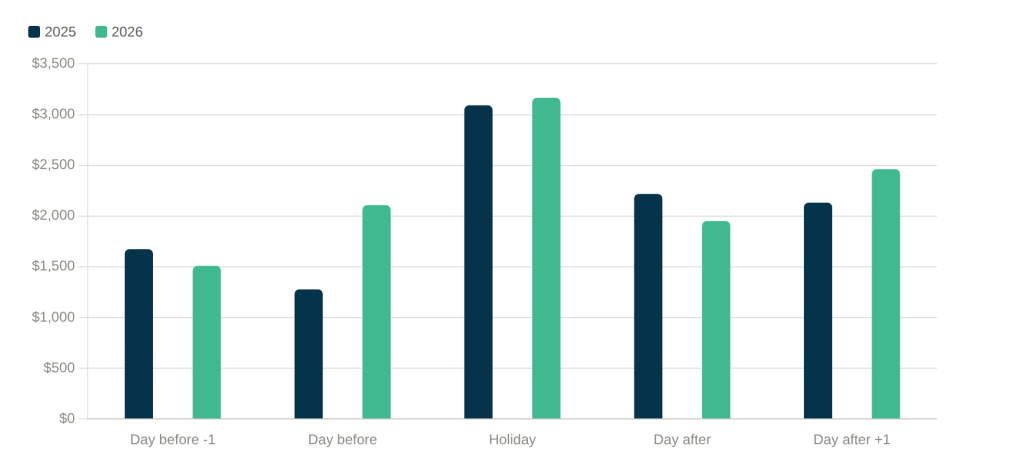
Average ticket is the one consistent signal in mattress, mirroring furniture: the holiday is the peak ticket day both years ($3,091 in 2025, $3,165 in 2026), even though it wasn’t the peak traffic day in 2025. Mattress shoppers who come out specifically on the holiday appear to spend more per visit, regardless of which day of week the holiday lands on.

Daily Revenue

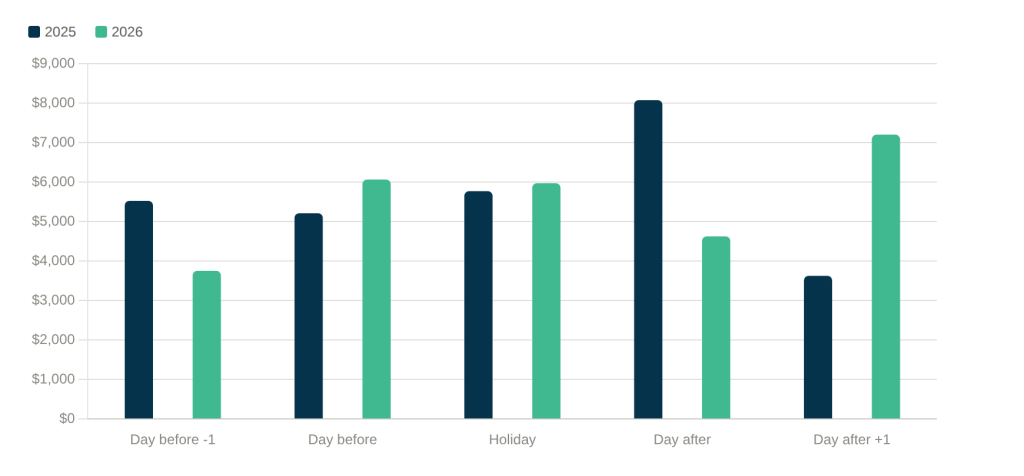
Revenue also shifted later in the window: 2025’s biggest mattress-spending day was the Saturday after the holiday ($8,082), while 2026’s was the Monday two days later ($7,206) — a later peak despite the earlier traffic peak, likely reflecting the small sample more than a real pattern.

Conversion Rate

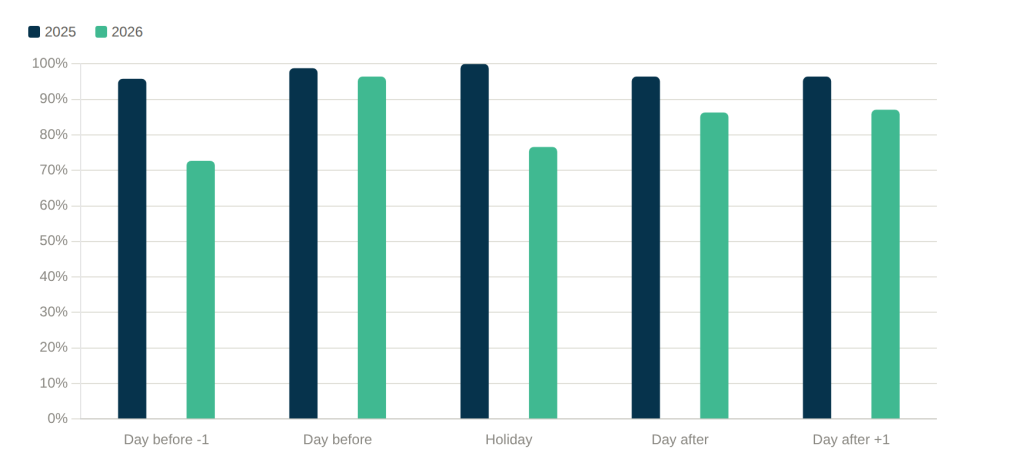
This is where 2026 diverges sharply from 2025, and where the small sample size matters most. In 2025, the top-tier mattress stores converted at 96–100% for essentially the entire window — an unusually tight, saturated band. In 2026, conversion was meaningfully lower and more variable: 72.7% on day before-1, dipping further to 76.6% on the holiday, before climbing to 86–87% by the end of the window. Only day before (96.4%) matches 2025’s level.

Conclusion

The clearest story to come out of this year’s data is timing, not performance. Furniture traffic and revenue didn’t shrink so much as they moved: 2025’s holiday weekend built toward a Saturday peak, while 2026’s peaked the day before the holiday and tapered off from there — a natural consequence of the 4th landing on what’s normally already the busiest shopping day of the week. Despite that shift, furniture held its conversion efficiency steady, and in most cases even edged out last year, suggesting the change in shopper timing didn’t come at the cost of sales execution.

Mattress told a noisier story, reflecting a smaller, more volatile slice of the market. Average ticket size was the one consistent throughline across both industries: the holiday itself was the highest-spending day in both years, reinforcing that whoever shows up specifically on July 4th tends to be a more committed, bigger-basket shopper — regardless of which day of the week that holiday falls on.

Taken together, this year’s numbers are less a story of the holiday getting weaker or stronger, and more a reminder that a floating holiday can quietly reshuffle an entire weekend’s traffic pattern — a dynamic worth watching again next year, when July 4th shifts to a Sunday.

Join the thousands of brick-and-mortar business pros who count on Retail Traffic Trends to get the latest data and insights on how to build a better business and see what’s around the corner.

Subscribe to our Retail Traffic Trends Newsletter for free today and stay tuned for new essential insights every Thursday.

Enter your email address to subscribe to Retail Traffic Trends.

We’re committed to your privacy. Trakwell uses the information you provide to us to contact you about our relevant content, products, and services. You may unsubscribe from these communications at any time. For more information, check out our Privacy Policy.

More Insights